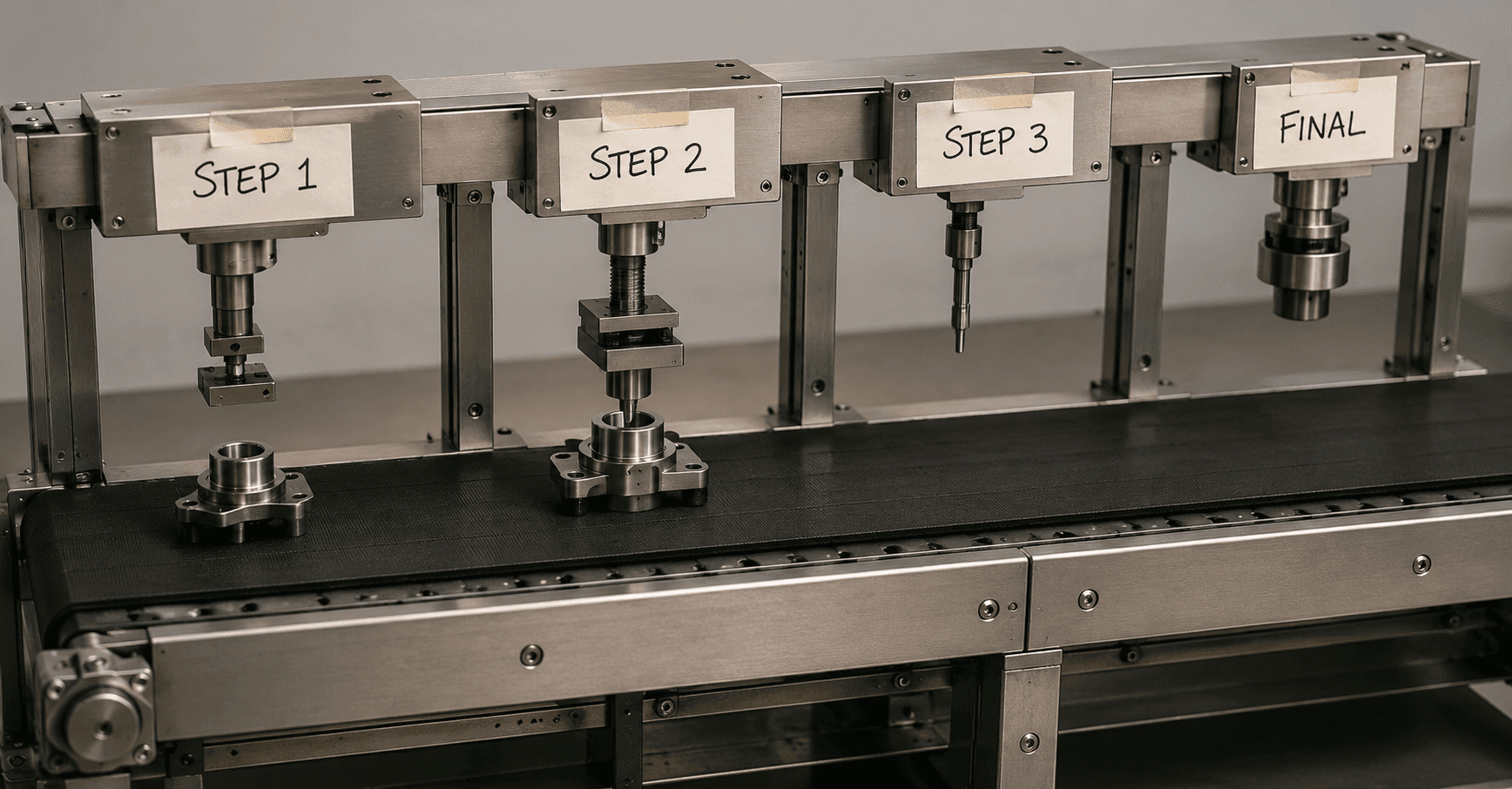
You have a method.
You sit with clients, walk them through a sequence, ask the questions in the right order, and produce a result that looks similar every time. That is your delivery.
Then you put it inside ChatGPT, hoping to build a structured ChatGPT workflow around your method.
Maybe you wrote a Custom GPT. Maybe it is a shared prompt or a project file. Either way, the goal was the same: let the client move through your method without you in the room.
First client gets steps one through five. Second client jumps straight to step three. Third asks about something tangential, and the conversation never finds its way back. By the time you look at the chat afterward, you cannot tell whether your method was delivered, half-delivered, or replaced by something the model invented on the spot.
The problem is not the model. The problem is that nothing underneath the conversation is enforcing sequence, requiring outputs, or saving a record you can review. That gap is what a structured ChatGPT workflow is built to close.
TL;DR
- A structured ChatGPT workflow is enforced sequence, required outputs at each step, and a saved reviewable record, not a better prompt or a tidier project folder.
- For service businesses, the value is not personal productivity. It is reproducible delivery: every client moves through the same steps, and the work product is inspectable afterward.
- The layer that makes that possible is not a smarter model. It is structure underneath the chat.
What a Structured ChatGPT Workflow Actually Is
Most articles on this topic define a structured ChatGPT workflow as better prompts, organized folders, or a feature like Projects or Skills.
Those are real tools. They are not what a service business actually needs.
For a service business, a structured workflow has three properties:
- a sequence the client must move through in order,
- required outputs at each step before the next one begins,
- and a saved record of what the client said and what the system produced.
Without those three, the interaction is still a chat. A clever chat, maybe. A chat with extra context loaded into it. Still a chat.
A structured ChatGPT workflow is what happens when those three properties are present and enforceable, not optional. The client cannot skip ahead. The model cannot improvise a new step. The session leaves a record the business can read.
That is the actual definition, and it builds directly on the broader case for why ChatGPT alone does not produce reliable outcomes without workflow structure.
Why Service Businesses Need a Step-by-Step Process More Than Productivity Users Do
When a productivity user asks ChatGPT to draft an email, the worst case is a bad email. They notice, they revise, they move on.
When a service business gives a client a ChatGPT-powered experience, the worst case is different. The client gets a session that did not deliver the methodology, and there is no record of what happened.
That is a different category of failure.
For a consultant with a diagnostic, a coach with an intake flow, or an agency with a discovery sequence, the value of the engagement depends on every client being walked through the same steps in the same order. If the experience drifts, the offer drifts with it.
Every session that ends without a structured record is a session you cannot build on. The next call starts from zero.
Productivity users can tolerate a loose AI. Service businesses cannot, because their work product depends on reproducibility. That is the deeper case behind productizing a coaching or consulting framework with AI instead of treating it as another productivity hack.
The Three Things a Vanilla ChatGPT Conversation Cannot Do
A normal ChatGPT conversation, even a well-prompted one, is missing three things service businesses need.
Enforced sequence
In a normal chat, the client steers. They can ask anything in any order, change topic, skip ahead, or stop early. There is no mechanism inside the model that says "you must complete the discovery question before the diagnostic question."
A structured workflow has that mechanism. The next step does not open until the current step is complete.
Required outputs
A chat answer is whatever the model produces. A workflow step has a defined output: a saved field, a captured response, a structured artifact. If the output is not produced, the step is not done.
That is what makes the work product comparable across clients. Every session yields the same set of artifacts, not a different transcript each time.
A reviewable record
The default ChatGPT chat lives inside the client's browser. The business cannot see it, cannot compare it across clients, cannot find any pattern in it.
A workflow run is the opposite. The business owns the record. It can be reviewed in seconds. It can be compared across clients. It can be used to refine the methodology over time.
That last one is what most service businesses underestimate. The session record is the asset. Without it, every client interaction is a one-off, no matter how strong the underlying conversation was. It is also a direct reason why most custom GPTs still fail at lead capture: the GPT may collect interesting answers, but the business never sees them in a usable form.
What a Structured ChatGPT Workflow Changes for the Service Business
Once those three properties are in place, the service business gets back something most assumed they had given up by introducing AI into the delivery.
They get reproducibility.
The same intake gets run the same way for every client. The same diagnostic produces the same artifact every time. The same discovery sequence ends with the same captured fields. The model is still doing the language work, but the structure is doing the delivery work.
That is the difference between a productivity boost and a delivery system.
A coach can review what each client said before the next session. A consultant can compare diagnostic answers across a cohort. An agency can hand off a completed intake without rereading a chat transcript.
None of that is possible inside an open conversation, no matter how careful the prompt. If you want to see how structured your current AI workflow actually is, take the free quiz.
Where Most Service Businesses Get Stuck Building a Structured ChatGPT Workflow
Most service businesses that have tried to do this with off-the-shelf tools end up in one of three places.
They have a Custom GPT that sounds sharp and produces inconsistent results. They have a Projects folder that organizes their own work but cannot be shared with a client. They have a Skill or a prompt library that depends on the user already knowing how to use it.
None of those produce reproducible delivery. They produce better personal productivity for the business owner, which is a different problem.
The layer that is missing in all three cases is the one this article has been describing: enforced sequence, required outputs, saved review. For a coaching-specific worked example of that pattern, see how to build a custom GPT workflow that stays on script.
This is where PacedLoop fits. It is built around the idea that a service business should be able to take an existing methodology, encode it as a workflow, and run every client through it the same way, with the record saved at the end.
Frequently Asked Questions
What is a structured ChatGPT workflow?
A structured ChatGPT workflow is a system that wraps ChatGPT in enforced sequence, required outputs at each step, and a saved reviewable record of what the client said and what the model produced. It is not a better prompt and it is not the Projects feature. It is the layer that turns an open conversation into a reproducible delivery process.
My Custom GPT goes off script and clients do not follow the process. What is missing?
The missing piece is structure underneath the model. A Custom GPT is still a chat, and the client can take it anywhere they want. To stop the drift, the experience needs enforced steps, completion rules, and a record the business can review afterward. Without those, even a carefully written GPT will produce a different conversation every time.
How do I make ChatGPT follow a step-by-step process for every client?
Move the structure out of the prompt and into the workflow. A single prompt, however detailed, cannot enforce sequence on its own. A workflow defines each step, what the client must produce before moving on, and where the saved output lives. That is how every client moves through the same process, regardless of how their session goes.
What This Gives You
What you get from a structured ChatGPT workflow is a delivery system, not a chat experience. Every client moves through the same sequence. Every response gets saved in a form you can read in 60 seconds. Your methodology gets delivered the same way every time, without you in the room.
That is what PacedLoop is built to provide.