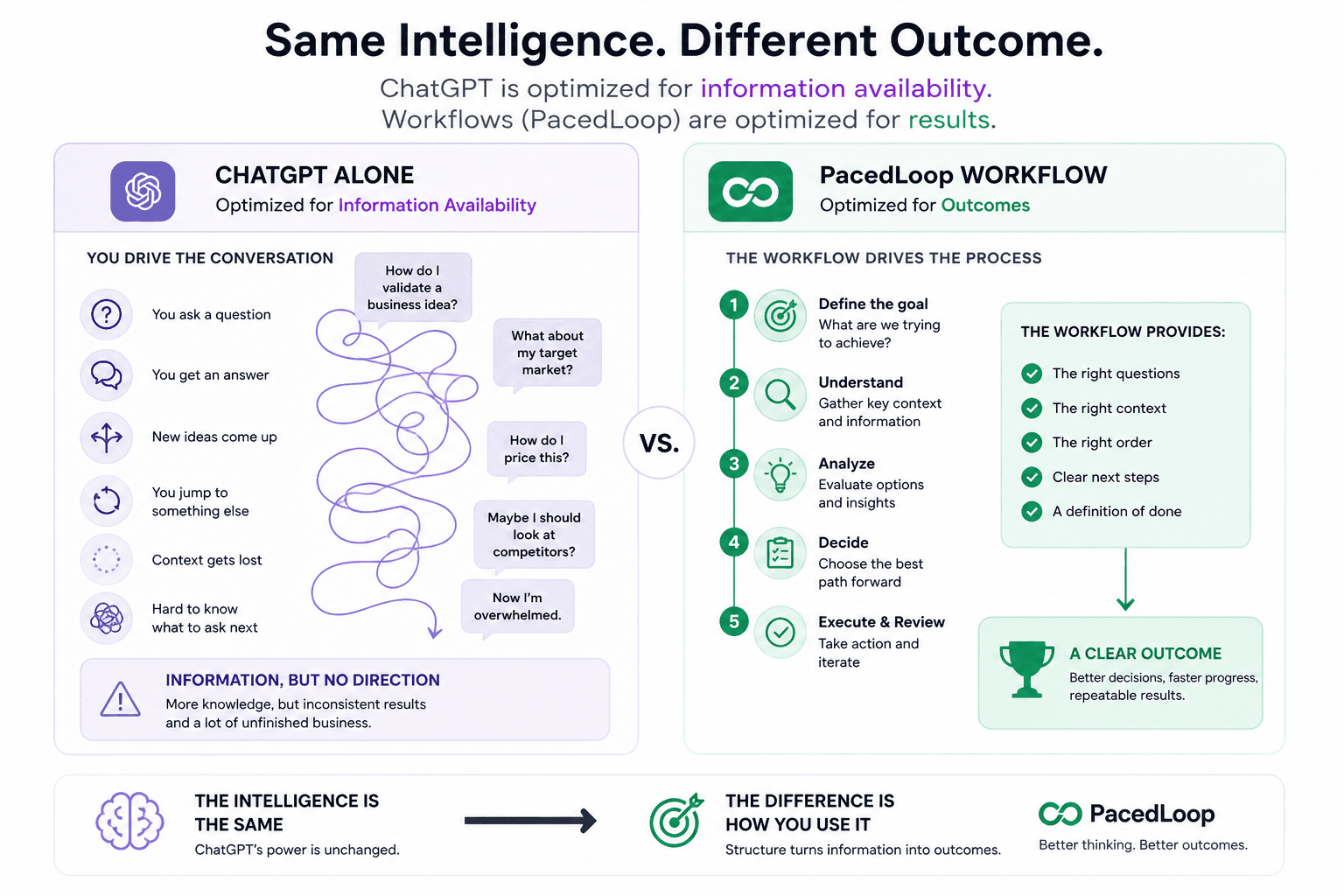
ChatGPT is extremely good at answering questions.
That is not a trivial strength. A person can go from zero to a working understanding of a topic in minutes. In terms of information access, it is one of the most powerful tools most people have ever touched.
But there is a difference between getting answers and getting somewhere.
What PacedLoop solves for lives inside that difference. That is the ChatGPT prompt vs workflow gap in practice.
TL;DR
- ChatGPT is strong at answering questions, but answers alone do not create reliable outcomes.
- Workflows add sequence, context carry-forward, and a clear definition of done.
- PacedLoop does not replace the model. It adds the structure that turns useful conversations into repeatable results.
ChatGPT Prompt vs Workflow: Why Answers Without Structure Fall Short
PacedLoop exists for a simple reason: useful AI conversations do not automatically produce reliable outcomes.
ChatGPT can help a user think, explore, compare, and generate ideas. But in many real situations, that still leaves a gap between interaction and result.
The missing pieces are usually things like:
- sequence,
- context carry-forward,
- ordered decisions,
- visible progression,
- and a clear definition of done.
That is the actual problem PacedLoop solves for.
It is not trying to replace the intelligence of the model. It is trying to make the use of that intelligence more structured, more trackable, and more outcome-directed.
ChatGPT Is Optimized for Information
The core promise of ChatGPT is availability.
You ask, it responds. You probe deeper, it follows. You change direction, it meets you there too. That flexibility is exactly what makes it so useful for exploration, learning, brainstorming, and rapid explanation.
In that sense, ChatGPT is optimized for information availability.
It can help with:
- learning a new concept,
- comparing options,
- clarifying unfamiliar language,
- exploring a problem from multiple angles,
- and generating possible next steps.
That is real value.
But information availability is not the same thing as outcome reliability.
The Hidden Dependency Most People Miss
ChatGPT works best when the user asks the right question in the right way, with the right context, often in the right sequence.
That is a much higher bar than most people realize.
Good results often depend on things like:
- what question comes first,
- what should be clarified before moving on,
- what context needs to be carried forward,
- what assumptions need to be tested,
- and what "done" should actually look like.
Most users do not naturally manage all of that well.
They jump around. They ask things out of order. They skip foundational decisions. They lose track of what has already been established. As the conversation gets longer, the thread often gets looser rather than tighter.
So even though the model is powerful, the outcome becomes inconsistent.
This is the core issue: the intelligence is there, but the process around it is often too loose to use it well.
If you want to see how structured your current AI workflow actually is, take the free quiz.
What Goes Wrong Without Structure
This is not really a model problem. It is a sequencing problem.
A person can spend thirty minutes inside a strong AI conversation and still leave with:
- a vague plan,
- unresolved tradeoffs,
- scattered ideas,
- half-made decisions,
- or a pile of useful language that never becomes action.
That is why many AI interactions feel productive in the moment but do not reliably produce progress.
The system gave answers. It did not enforce a path.
If the user does not already know how to structure the thinking process, the conversation can stay informative without becoming decisive.
How a Structured ChatGPT Workflow Changes What the Interaction Can Do
A workflow does not replace ChatGPT. It organizes it.
That is the distinction.
The model can remain exactly the same. The access can remain exactly the same. What changes is the structure around the interaction.
PacedLoop adds the workflow layer that defines:
- what question comes first,
- what context is preserved,
- what must be decided before the next step,
- what output is expected at each stage,
- and what counts as completion.
That changes what the interaction can actually do.
Instead of relying on the user to design the thinking process while also participating in it, PacedLoop provides the sequence. The interaction becomes more grounded, more ordered, and more likely to produce a usable result.
This is the difference between a tool that is optimized for information and a system that is optimized for outcomes.
The ChatGPT Prompt vs Workflow Distinction, Shown Through Simple Analogies
One of the easiest ways to understand the role of workflows is through comparison.
ChatGPT without workflow structure is closer to a map. Useful, flexible, and full of information. But PacedLoop is more like a GPS. It helps determine the next move, maintain direction, and reduce drift.
The same pattern shows up in other situations:
- A recipe is more useful than a pile of ingredients when the goal is a finished meal.
- A meeting with an agenda is more likely to produce progress than a meeting without one.
- A personal trainer creates a better execution environment than simply walking into a gym.
- A doctor appointment produces more directed next steps than reading WebMD alone.
- An outline leads to more coherent writing than pure stream-of-consciousness drafting.
None of those analogies say the raw materials are useless.
The map matters. The ingredients matter. The gym matters. The medical information matters.
The point is that access alone is not the same as structured progress.
What PacedLoop Solves for Experts and GPT Creators
This distinction matters most when the goal is not casual exploration, but a real business or learning outcome.
If you are a coach, consultant, advisor, teacher, strategist, or GPT creator, you usually do not want the user to simply have an interesting conversation.
That is also how coaches and consultants already shape intelligence through structured AI workflows, and it is the same logic PacedLoop applies.
You want them to move through a process.
What you usually need is not just a smart model. You need a process that can:
- the right issues surfaced in the right order,
- context captured before the next step,
- important decisions made explicitly,
- responses organized in a usable way,
- and create a clear handoff into review, action, or follow-up.
PacedLoop solves for that operational gap.
Without that structure, even a very good AI interaction can remain operationally thin.
It may feel helpful while still leaving you with no durable path, no consistent process, and no reliable way to compare one user's progress with another's.
Why Structured Workflows Matter More Than a Smarter Prompt
This is where PacedLoop fits.
PacedLoop is not trying to out-answer ChatGPT.
It is trying to add the sequence, structure, and finish-state logic that most users do not create on their own.
That means the core value is not "better intelligence" in the abstract. The core value is a better path through the intelligence that already exists.
The simplest way to say it is this:
ChatGPT gives you answers. PacedLoop makes sure you arrive somewhere.
That is the real positioning difference.
Same model. Same access. Better sequence.
That sequence is also what makes it possible to see how ChatGPT workflows generate business intelligence when structured correctly.
When to Stop Prompting and Start Building a Workflow
If you already have a real framework for how people should think, decide, qualify themselves, or move through a learning process, then the missing layer is probably not more intelligence.
It is structure.
That is what turns open-ended AI into a guided system.
That is what makes context easier to carry forward.
That is what makes outcomes more consistent.
That is what PacedLoop solves for.
And that is why workflows matter even when the model itself is already strong.
Frequently Asked Questions
What is the difference between a ChatGPT prompt vs workflow?
A ChatGPT prompt is a single input that generates a response. A workflow adds sequence, structure, and defined steps around those prompts so the interaction moves toward a specific outcome. The difference matters when you need consistent, reviewable results rather than one-off answers. PacedLoop provides the workflow layer that makes that structure possible.
Why does my GPT keep going off track even when I give it detailed instructions?
A single prompt, however detailed, does not enforce a sequence. Without a workflow, users can redirect the conversation at any point, skip steps, or lose context as the session continues. PacedLoop solves this by wrapping the interaction in a defined step-by-step process that the model follows regardless of how the conversation develops.
How do I make ChatGPT follow a step-by-step process for every client?
The most reliable way is to move from a prompt-based setup to a structured workflow. Instead of writing one large instruction, you define each step, what context it needs, and what the expected output is. PacedLoop is built for this, letting coaches and consultants create structured ChatGPT experiences their clients move through step by step.
Get Your Free GPT Built
If you already have a framework, diagnostic, intake flow, or guided process you want to turn into a structured GPT experience, this is exactly what PacedLoop is built to support.