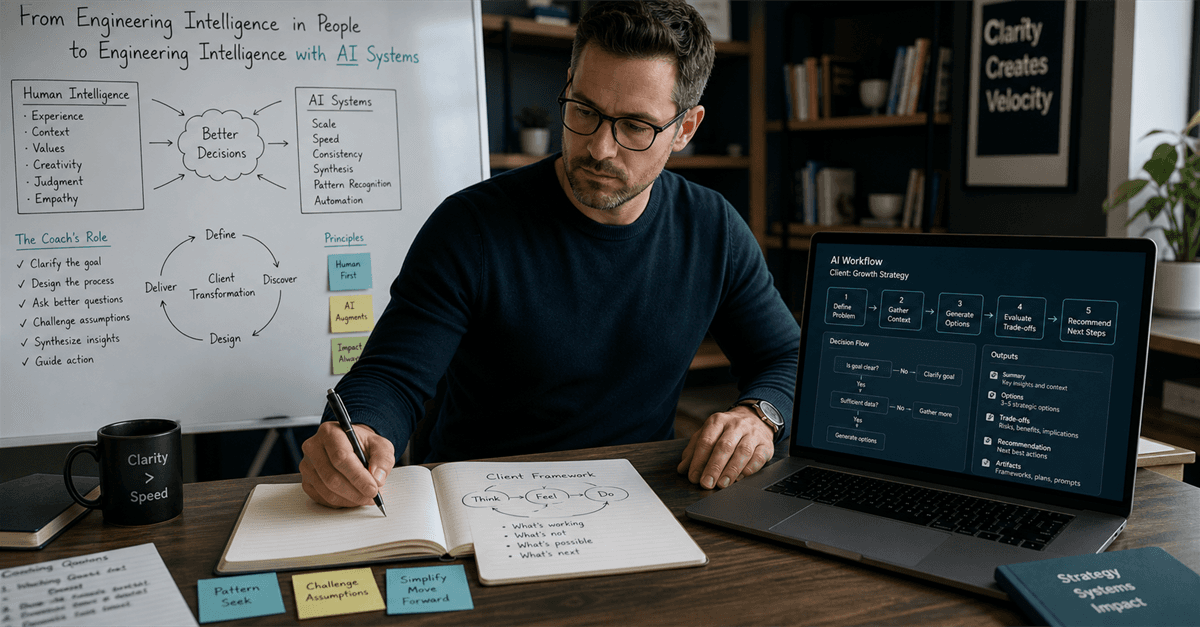
Most AI advice for coaches and consultants is too shallow.
It usually sounds like this: learn better prompts, try more tools, automate more content, move faster.
That advice is not useless.
It is just aimed at the wrong bottleneck.
For most coaches and consultants who want to productize their consulting framework with AI, the real bottleneck is not producing more answers.
It is carrying thinking through to execution in a way that is structured, consistent, and complete.
TL;DR
- The bottleneck is not more AI output. It is translating your method into sequence, context, and completion logic.
- Coaches and consultants already shape intelligence through guided thinking. AI becomes more useful when that guidance is encoded into a workflow.
- Productizing a framework with AI means building a structured delivery system, not writing a better prompt.
How Coaches and Consultants Already Have the Expertise to Productize Their Framework with AI
A coach helps someone think more clearly.
A consultant helps someone structure decisions, test assumptions, and move from ambiguity to action.
That work is not just expertise in the abstract.
It is the work of shaping intelligence in another person.
The professional value is not only in what the coach or consultant knows. It is in how they help another person interpret reality, organize thought, improve judgment, and move toward better action.
That has not changed.
Why AI Changes How Consultants Deliver a Structured Framework to Clients
There is now a new layer inside that work: AI.
Most people use AI to generate answers.
But answers are not the real bottleneck.
Execution is.
A single prompt can produce a response. It can give you language, options, or a quick synthesis.
What it usually does not do on its own is make sure thinking is followed through, refined, and completed in the right order.
That is where systems matter.
The Real Opportunity: Encode Your Thinking Into a Structured ChatGPT Workflow
The opportunity for coaches and consultants is not simply to become more technical.
It is to encode how they think into a structured process that can be carried forward consistently.
That means translating expertise into a system with:
- sequence,
- context carry-forward,
- decision structure,
- constraints,
- and completion logic.
Those pieces matter because they determine whether AI remains a source of loose answers or becomes a useful support layer inside a real process.
When those elements are in place, AI stops being just a tool for generating language and becomes a tool for supporting structured thinking.
Prompts Are Not the Same Thing as Execution
This is the difference many people miss.
A prompt can give you an answer.
A system can help produce a reliable outcome.
That distinction is especially important for coaches and consultants because their clients are not paying for more words. They are paying for clearer thinking, stronger decisions, and better follow-through.
If AI is inserted into that work without structure, it often creates the appearance of progress without actually creating completion.
If AI is placed inside a well-designed sequence, it can help extend the coach or consultant's method without flattening it.
Understanding why ChatGPT alone does not produce reliable outcomes without workflow structure makes this distinction more concrete.
What a Productized Consulting Framework with AI Looks Like in Practice
For a coach, this might mean turning a reflection or intake process into a guided sequence that:
- captures the right context up front,
- asks questions in the right order,
- preserves the client's prior answers,
- and creates a usable handoff into the next session.
For a consultant, it might mean turning a diagnostic or decision process into a structured workflow that:
- clarifies the problem first,
- surfaces assumptions before recommendations,
- organizes tradeoffs explicitly,
- and produces a reviewable outcome instead of a loose conversation.
In both cases, the value is not that AI said something intelligent.
The value is that the professional encoded a thinking process that can now be carried forward more consistently.
Why PacedLoop Fits This Better Than Ordinary Chat
This is where PacedLoop's positioning becomes useful.
Open-ended chat can be informative. It can generate ideas, alternatives, and language.
But useful interaction is not the same thing as reliable execution.
PacedLoop is built around the idea that systems should help guarantee completion, not just produce answers.
That means the structure matters:
- what happens first,
- what context is preserved,
- what must be decided before moving on,
- what output is expected,
- and what counts as done.
That is a much closer match to how strong coaching and consulting frameworks actually work.
If you want to see how structured your current AI workflow actually is, take the free quiz.
Where the Real Leverage Is When You Scale Your Consulting Framework with AI
The professionals who understand this will not replace their expertise with AI.
They will extend it.
Their frameworks will not live only in documents, slide decks, prompts, or live sessions.
They will increasingly live in systems that guide thinking step by step, with AI assisting inside each step.
This is how ChatGPT workflows generate business intelligence beyond individual answers when structured correctly.
That is where the leverage is.
Not more AI.
Better execution of how thinking actually happens.
How to Turn Your Consulting Framework Into a Custom GPT for Consultants
If you are a coach or consultant and you already have a guide, checklist, assessment, worksheet, or intake process, that is often enough to start.
PacedLoop helps turn that existing resource into a structured GPT workflow that guides people step by step, captures responses, and gives you review-ready context instead of a loose chat transcript.
Frequently Asked Questions
How do I productize my consulting framework with AI?
Most consulting frameworks live in documents and live sessions. To productize your consulting framework with AI, you need to encode the sequence, context, and decision logic into a structured workflow rather than a single prompt. PacedLoop is built for this: it lets you define each step of your framework, carry client responses forward, and produce a reviewable output instead of a freeform conversation.
My Custom GPT goes off track and clients do not follow my process. What can I do?
This is the most common issue with open-ended GPT tools. When a GPT has no enforced sequence, clients can ask anything and the session becomes unstructured. PacedLoop solves this by building step-by-step workflows where each step has defined instructions, required inputs, and completion logic, so clients move through your methodology rather than around it.
Can I make ChatGPT follow a step-by-step process for every client?
Yes, but not with a standard Custom GPT. The native ChatGPT interface is open-ended by design. To make ChatGPT follow a step-by-step process reliably, you need a structured workflow layer that defines what happens first, what context is carried forward, and what counts as done. That is what PacedLoop provides.
What is the difference between a consulting framework and a GPT workflow?
A consulting framework is your method: the sequence of questions, decisions, and outputs that define how you work with clients. A GPT workflow is the structured system that carries that method forward through a digital interaction. When you build a GPT workflow that matches your consulting framework, you can deliver your methodology at scale without reducing it to a single prompt.