You already run client diagnostics from a repeatable consulting framework.
That is what most people want from a GPT workflow builder.
The first ten minutes follow the same path. One question narrows the scope. The next exposes the real constraint.
Then you try to turn that process into a GPT. By the third turn, the model has skipped a question, answered too early, or let the client pull the session off path.
That breaks more than the chat. The handoff gets weaker, the notes get looser, and the next decision starts from reconstruction instead of method.
The problem is not the GPT. It is that the GPT has no structure underneath it.
TL;DR
- A GPT workflow builder fails when it is only one long instruction with no enforced stage order.
- Start with one repeatable client path, then define what each step must capture before the next one opens.
- The value is not a smarter chat. It is a reviewable workflow that keeps your framework on script.
Why a GPT workflow builder fails when it starts as one big prompt
Most people approach a GPT workflow builder as if the builder itself is the workflow.
The builder is only the container. The real workflow is the order of decisions, the sequence of questions, and the rules for what has to be captured before the session can move forward.
A prompt can describe that structure. A workflow can hold it in place.
Framework-delivery consultants often already know this in live work. They do not run a diagnostic by intuition alone. They move through a path. They establish context, test assumptions, surface constraints, and only then decide what recommendation belongs next.
When all of that gets collapsed into one instruction box, the GPT is forced to juggle too much at once:
- role,
- tone,
- sequence,
- decision logic,
- and output requirements.
The result usually looks competent for a turn or two. Then the model starts behaving like what it is best at being: a responsive conversation partner.
The client adds detail that sounds interesting. The model follows it. A required question never gets asked. A recommendation appears before the diagnosis is complete. By the end, the consultant has a polished exchange and a weak artifact.
A transcript is not a process.
That is the difference behind why ChatGPT needs workflow structure.
That distinction matters because the consultant is not trying to create a chatbot that sounds thoughtful. The consultant is trying to carry a method through a repeatable client interaction.
What part of your framework a GPT workflow builder should handle first
The consultant who tries to turn the whole method into one GPT usually gets a vague assistant instead of a controlled system.
Start smaller.
Pick one client path that already repeats in your business. Not the whole engagement. Not the entire framework. One path.
That is the same discipline behind how to build a custom GPT workflow for coaches.
For a framework-delivery consultant, the best first path is usually one of these:
- a pre-call diagnostic,
- a scoping intake,
- a readiness assessment,
- or one guided exercise that always follows the same order.
Those are strong starting points because they already have internal structure. The questions are familiar. The outputs are comparable. The handoff point is clear.
Many people assume a GPT workflow builder becomes more valuable as the scope grows. The opposite is usually true at the beginning. A narrow flow gives you a real chance to see whether the system can protect your method.
The easiest way to test the candidate path is to ask four questions:
- What does the client need to understand first?
- What does the consultant need to know before advising?
- What must be saved before the next step?
- What counts as complete?
If those four answers are fuzzy, the flow is not ready yet.
No-code is not no-design.
The consultant still has to design the sequence. The builder removes implementation friction. It does not remove the thinking required to make the workflow dependable.
What a no-code GPT workflow builder still cannot decide for you
Many articles about GPT workflow builders stay too shallow because they explain setup, not operating logic.
The hard part is deciding how your framework behaves under pressure.
A no-code builder cannot answer questions like:
- what information is required before diagnosis,
- which question cannot be skipped,
- where the recommendation should stop,
- or what the consultant must review before the next action.
Those are framework decisions.
It is the same shift involved in productizing a consulting framework with AI.
If you do not make them explicitly, the GPT will improvise. It will sound helpful while quietly flattening the method that made your consulting work valuable in the first place.
That is why the strongest build constraint is not technical. It is operational.
You have to choose what the GPT is allowed to do, what it is not allowed to do, and where it must stop and leave a usable record behind. A consultant who ignores that boundary usually ends up with a session that feels active but produces no clean handoff.
Files can help the GPT sound more like your framework. They do not automatically make the interaction more structured. At the start, the better move is to load only the documents that define the method:
- the framework itself,
- one or two examples of strong outputs,
- a glossary of key terms,
- and any fixed rules the session has to respect.
That is enough to create discipline.
How to make ChatGPT follow a specific step-by-step process for clients
The cleanest approach is to break the interaction into small stages and give each stage one job.
Do not ask the model to gather context, diagnose the issue, challenge assumptions, and write the final summary all at once.
Make it earn the next step.
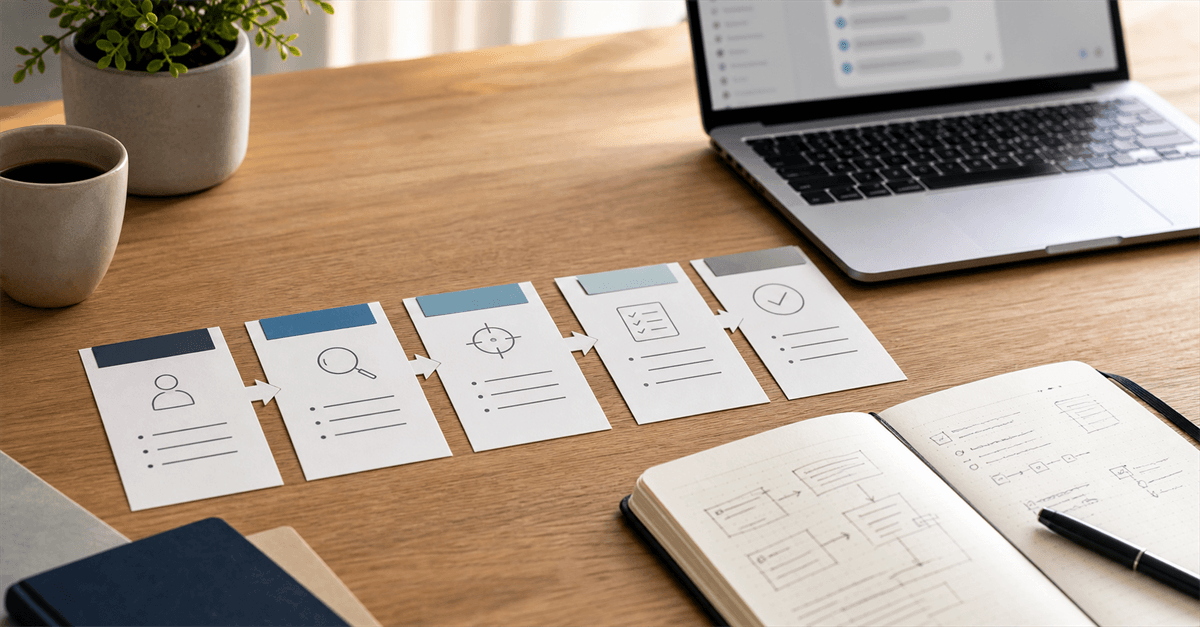
A practical flow for a framework-delivery consultant usually looks like this:
- context,
- diagnosis,
- constraint check,
- recommendation logic,
- and next action.
Each stage should answer one question. Each stage should require a specific input. Each stage should end with a small output the next stage can inherit.
That is how sequence becomes visible.
The other requirement is completion logic. The system needs a rule for what counts as done inside the stage. A vague answer should not automatically pass. A missing constraint should not disappear because the chat felt productive.
This is where the consultant's rigor has to survive translation into the workflow. If the live method would pause and press for clarity, the GPT flow has to do the same. If the live method would not recommend a direction before a certain input exists, the GPT flow cannot do it either.
That does not make the interaction robotic. It makes the interaction calm.
Clients usually do not resist structure when the sequence makes sense. What they resist is confusion. They resist feeling that the system is jumping around, answering before understanding, or asking questions that do not seem to lead anywhere.
A guided flow feels better because the path is clearer. It is not less human. It is less loose.
What a structured GPT workflow builder needs to save after every session
The workflow is only useful if the consultant can review what happened without rereading a long chat.
That means the session needs to leave behind an artifact. Not just language. An artifact.
For most consulting flows, that artifact should capture a compact version of:
- the stated problem,
- the operating context,
- the real constraint,
- the decision pressure,
- and the agreed next action.
Those fields are not administrative leftovers. They are the backbone of the handoff.
Every client session that ends as a loose transcript is a session you cannot compare, review, or build on. The next decision starts from memory instead of evidence.
That is the real price of weak workflow structure.
If you want to see how structured your current AI workflow actually is, take the free quiz.
This is where PacedLoop fits. It holds the sequence, saves the outputs, and gives the consultant something reviewable after the session ends.
Once the artifact is structured, the consultant can do practical things with it:
- scan before the next call,
- compare patterns across leads,
- see where the workflow keeps breaking,
- and refine the sequence based on real evidence.
Without that record, the GPT may still feel useful in the moment but leave the consultant with too little to improve the method or trust the handoff.
Where a GPT workflow builder becomes more valuable than plain chat
Plain ChatGPT still has a role.
If you are brainstorming interview questions, rewriting workshop language, or pressure-testing one idea, open chat is often enough. The task is one-off. The output does not need to be saved in a structured way. No client path depends on it staying in order.
That is not true when the interaction sits inside delivery.
If the client has to move through a repeatable method, if the next human decision depends on what gets captured, or if the consultant wants comparable outputs across sessions, then the workflow layer matters more than the chat layer.
That is how capture structured data from ChatGPT stops being a theory problem and becomes an operating one.
Many builder tutorials never draw that line clearly enough. Customization helps, but customization without enforced sequence still behaves like guided chat, not structured delivery.
That is why the right question is not, "Can I build this without code?"
The better question is, "Can this flow keep my method intact when the client starts interacting with it?"
If the answer is yes, the builder becomes strategically useful. If the answer is no, the consultant has only created a more branded version of drift.
Frequently Asked Questions
tools to structure Custom GPTs
The tool only solves the surface problem. The deeper issue is whether your method has clear stages, boundaries, and saved outputs. If those are missing, the GPT still behaves like a flexible chat instead of a controlled consulting path.
build a guided AI experience for consultants or coaches
Start with one repeatable path, not the whole business. Choose the part of your method that already follows a stable order, then define what each stage must collect before the next one opens. That is what turns the experience into guidance instead of improvisation.
My GPT goes off track
That usually means the GPT has too much freedom and too little sequence. Tighten the scope, narrow the job, and make completion visible at each stage. If the path is not enforced, the model will drift back toward open chat behavior.
make ChatGPT follow a specific step-by-step process for clients
Do not rely on one long instruction. Split the flow into stages, give each stage one purpose, and define what counts as complete before the session can continue. The more explicit the progression is, the more reliable the client experience becomes.
What the consultant gets back
What you get is a client record you can review in minutes, with each decision point in order and each required input captured before the next step begins. PacedLoop is the layer that makes that sequence hold.